
Chronology
Early Research
1580-1591
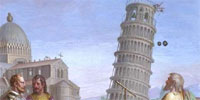

According
to the testimony of the Racconto istorico
della vita di Galileo [Historical
Account of Galileo's Life] (1654) by Vincenzo Viviani, in 1583 Galileo
deduced, from casual observation of the oscillations of the lantern in the
Cathedral of Pisa, the law of isochronism of pendulums and, between 1590 and
1591, conducted some experiments with free-falling bodies dropped from the
Leaning Tower. It is possible, however, that these experiments are merely part
of the legend that has formed through the ages around the figure of Galileo.
His
first research initiatives, strongly influenced by the great impression made on
him by Archimedes' model of investigation, based on strictly geometric methods
of analysis, were later to lead Galileo in the direction of affirmation of the
modern conception of motion. He was the first to establish the laws that
govern, in natural motions, the ratios between distance covered and time
employed, stating the principle of direct proportionality between acceleration
and time.